

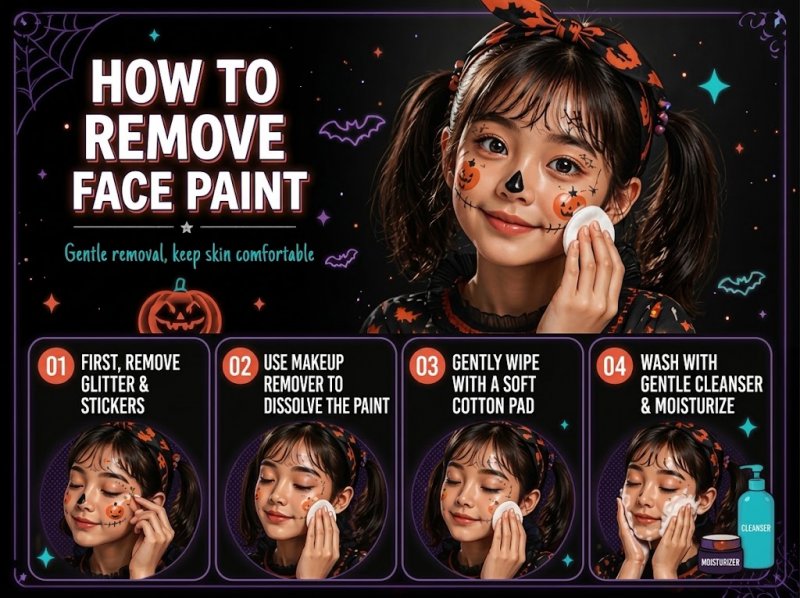
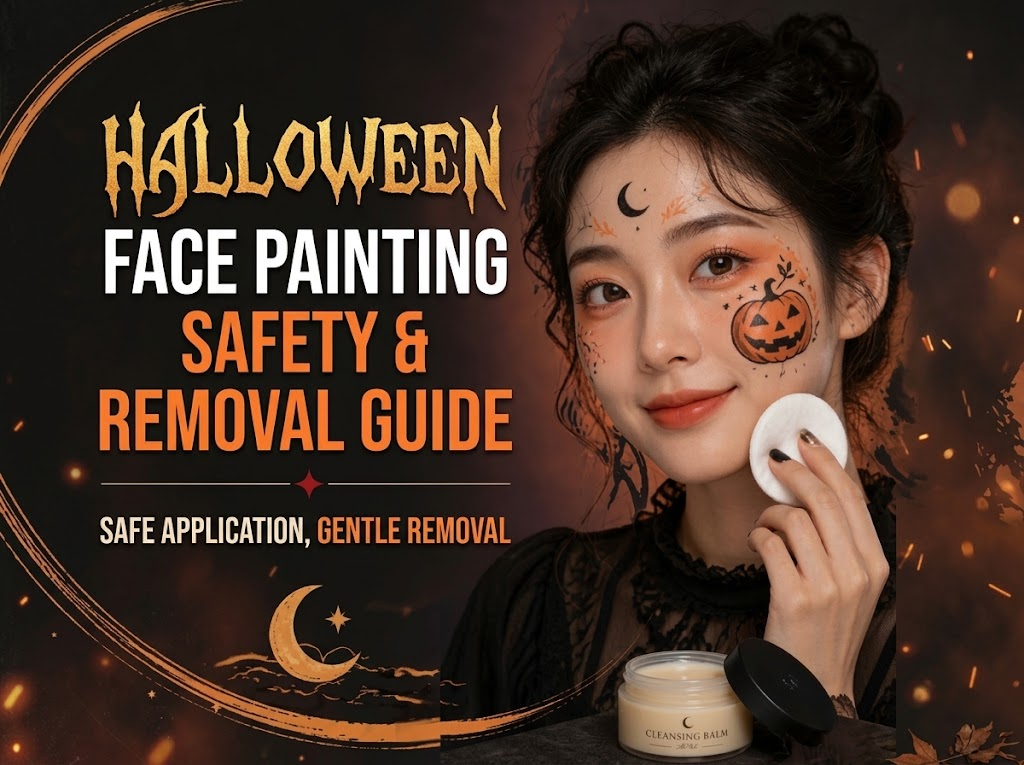
Halloween face painting is not necessarily harmful to the skin; most problems come from incorrect removal. Parents often make five mistakes: rubbing with wet wipes, using body wash or soap, rinsing with water only, skipping moisturiser, and using adult makeup removers. Correct removal for children includes removing gems or stickers, softening paint with warm water, massaging with a gentle cleanser, rinsing, checking the hairline, eyebrows and behind the ears, and moisturising immediately. Different paints need different methods: water-based paint with warm water and cleanser; oil paint with baby oil or Vaseline; glitter lifted with tape first; setting spray softened before washing. Sensitive skin should have a 24-hour patch test, and broken, eczema or irritated skin should not be painted. Choose EU CE-certified paints, avoid harmful ingredients, and use within 6–12 months after opening.
Key Points at a Glance
‧Most skin damage from face painting comes from incorrect removal, not the paint itself.‧Five common parent mistakes: rubbing with wet wipes, using body wash or soap, rinsing with water only, skipping moisturiser, and using adult removers.
‧Correct kids’ removal steps: remove gems or stickers, soften with warm water, massage with gentle cleanser, rinse, check residue, and moisturise immediately.
‧Water-based paint needs warm water and gentle cleanser; oil paint needs baby oil or Vaseline; glitter should be lifted with tape first; setting spray needs softening.
‧Sensitive skin needs a 24-hour patch test; do not paint broken, eczema or irritated skin.
‧Choose FDA- or EU CE-certified paints, avoid mineral oil, fragrance, alcohol and formaldehyde releasers, and use within 6–12 months after opening.
‧Safe Hong Kong brands include TAG, Fusion, Superstar and Silly Farm; professional painters should teach removal and follow up.
Halloween Face Painting Safe Removal Guide
A Must-Read for Parents: How to Remove Makeup Thoroughly Without Hurting Children’s Skin
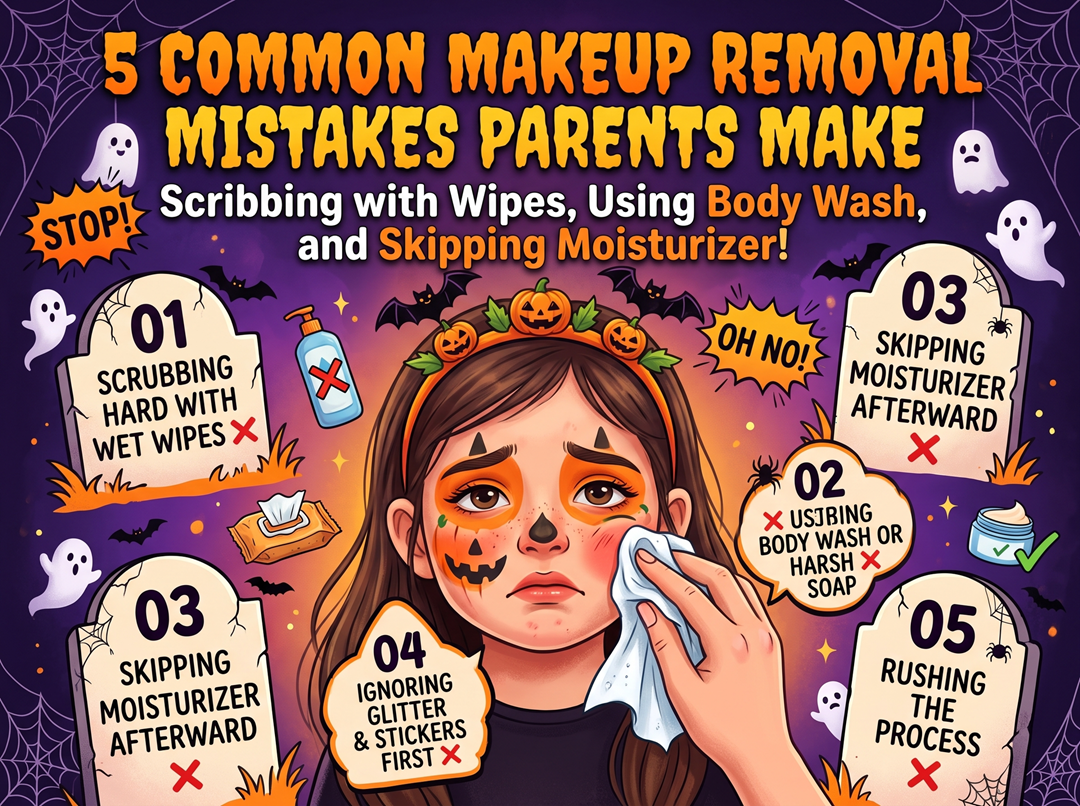
- Mistake 1: Scrubbing hard with wet wipes This is the most common and the most skin-damaging approach. Wet wipes are relatively rough; scrubbing hard wears away the stratum corneum. Children’s skin is thin, so it can easily turn red or even develop micro-tears. What’s more, the cleansing ingredients in wet wipes aren’t necessarily suitable for the face and may further irritate the skin.
- Mistake 2: Scrubbing directly with body wash or soap Body cleansing products are stronger and their pH isn’t suited to facial skin. Using them to remove face paint strips away too much sebum, leaving the skin dry and tight. Children who already have sensitive skin are even more likely to develop problems.
- Mistake 3: Assuming a rinse with water is enough Water-based face paints dissolve in water, but if there’s glitter, rhinestones or setting spray, plain water won’t wash them away. After rinsing you may think it’s clean, but pigment and glitter are still trapped in the pores; left overnight, they can clog pores.
- Mistake 4: Skipping skincare after removal Many parents stop once the paint is off and forget to apply moisturiser. No matter how gentle, removal always takes away some sebum. Without moisturising afterwards, the skin dries out and its resistance drops, making it more prone to sensitivity the next time.
- Mistake 5: Using adult makeup remover oils or waters Adult makeup removers may contain alcohol, fragrance, salicylic acid and other ingredients unsuitable for children. Makeup remover water in particular mostly contains alcohol and can be very irritating on a child’s face.
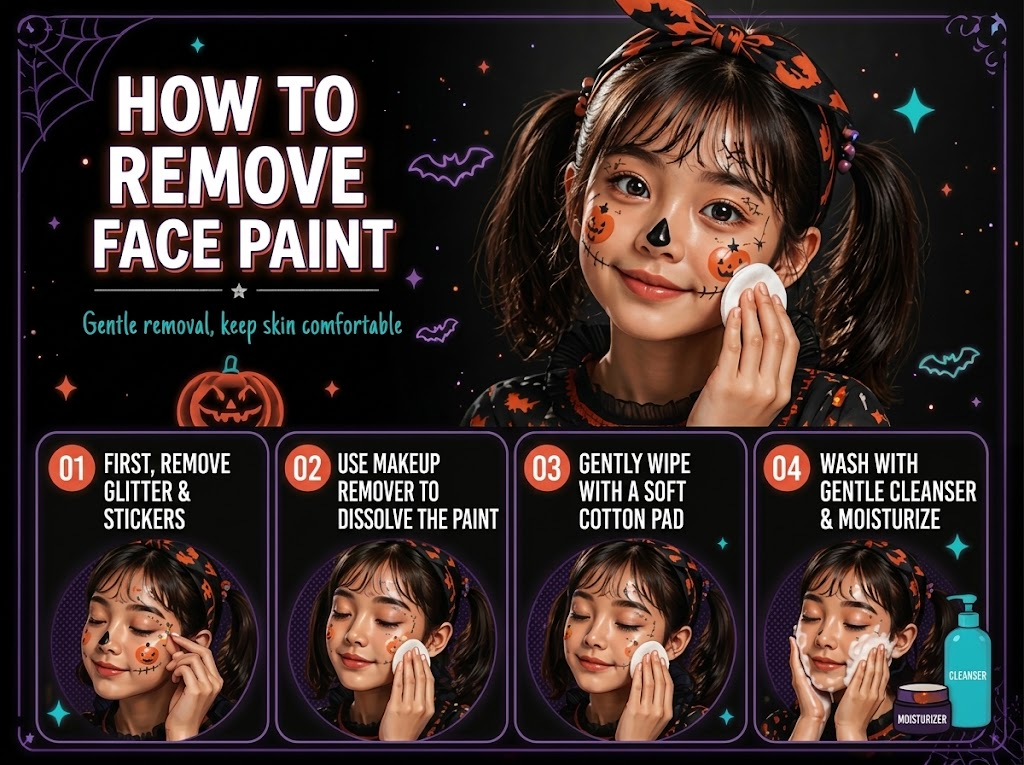
- Remove physical decorations first If there are rhinestones, stickers or fake lashes on the face, gently peel them off with your fingers first. Rhinestones are usually glued on — don’t yank them. Apply a little petroleum jelly or baby oil around the edges to soften the glue, then lift them off slowly to avoid pulling the skin or tugging out hair.
- Soften the paint with warm water Soak a towel or your hands in warm water (not too hot — around body temperature is enough) and gently press it over the painted areas for about 30 seconds so the water-based paint softens. This step is crucial: once softened, the paint lifts on its own, so there’s no need to scrub.
- Massage gently in circles with a mild cleanser Use a kids’ foam cleanser or fragrance-free body wash, add a little water, and massage gently in circles with your fingertips. You’ll see the paint start to dissolve. Don’t rush this step. For larger areas, press lightly with a sponge rather than rubbing.
- Rinse with water Rinse thoroughly with warm water to wash away the cleanser and the dissolved paint. Remember to check the corners: the hairline, eyebrows and behind the ears — these are the spots where glitter is most likely to linger.
- Check for residue After rinsing, pat dry gently with a clean towel (don’t rub), then check for any residue. If a little colour remains, repeat step 3. Water-based paint usually comes off completely within two passes.
- Moisturise immediately As soon as it’s clean, apply a mild moisturising cream or aloe vera gel to restore the skin’s protective barrier. Don’t skip this step.
- Water-based paint (most common) This is the standard method described above: warm water plus a mild cleanser. Most children’s face paints on the market are water-based — safe and easy to remove.
- Grease paint (stage makeup) Grease paint doesn’t dissolve in water; you need oil to remove it. Use baby oil, petroleum jelly or a professional makeup oil — apply it to the face and let the paint dissolve, then wash it off with a cleanser. Grease paint is usually used for professional stage makeup and is rarely used on children at Halloween.
- Glitter Glitter is the trickiest because it’s fine and light and easily gets into the hairline and eyebrows. To remove it, first use tape to gently lift the glitter off the surface, then wash with warm water and a cleanser. Don’t rinse it straight with water, or the glitter will spread everywhere and be even harder to clean.
- Glow / UV paint Glow paints are usually water-based, so they’re removed the same way as regular water-based paint. However, glow pigments may be coarser, so be extra gentle — no vigorous rubbing.
- Setting spray If setting spray was applied after painting, it forms a protective film that water struggles to penetrate. Apply a little baby oil or cleansing balm and leave it for a while to soften the film, then follow the normal removal steps.
- Look for safety certification: always buy water-based face paints certified by the FDA (US Food and Drug Administration) or carrying EU CE certification. Don’t buy watercolours or acrylic paints from ordinary art supply shops — these aren’t designed for skin and may contain heavy metals or harmful substances.
- Check the ingredients: avoid products containing mineral oil, artificial fragrance, alcohol or formaldehyde releasers. The simpler the ingredients, the better — especially for children.
- Mind the expiry date: once water-based paint is opened, it comes into contact with water and air and can easily breed bacteria. It’s generally recommended to use it within 6 to 12 months of opening. If the paint changes colour, smells odd or grows mould, throw it away immediately — don’t try to save it.
- Choose a professional face painter: if you’re going to an event or having someone come to your home, ask which brand of paint they use, whether they do patch tests, and whether tools are disinfected every time. A professional face painter will always proactively explain safety and removal precautions.
“I personally tell every parent the removal steps after each painting, and I print a small removal tip card for them to take home. Parents are really grateful, because many genuinely don’t know how to remove the paint — they’d scrub with wet wipes until the child cried. Thanks to this little detail, many parents come back to me for their next event and recommend me to friends.”
“I’ve worked in beauty for a long time, so I pay special attention to skin care. I recommend which kids’ cleanser to use, what moisturiser to apply after removal, and even sell gentle cleansing wipes to parents who need them. When clients see that you’re professional, they naturally trust you — my return rate is very high.”
“October is the busiest time. Once, a parent told me her child had reacted badly to face painting before and asked if I could still paint her. I did a patch test, used the gentlest paint, explained removal in detail, and even followed up on WhatsApp. After that, that parent promoted me all the time, saying I was the most careful face painter she’d ever met.”
- The Ultimate 2026 Halloween Face Painting Guide | Top 15 Looks for Kids & Adults
- Face Painting Beginner’s Guide | A Side Skill Anyone Can Learn From Zero
- Face Painting Safety Rules | A Complete Guide to Choosing Paints, Patch Testing and Tool Hygiene
- IQA Face Painting Certificate Course | From Basics to Advanced — Start Your Side-Career Journey